A community can take its own dances to a robot
Robots that dance exist, and so do archives that keep dance as movement. What this work adds is a chain that a community can run by itself: its own dances, recorded with four cameras, taken as far as a real robot with more than 250 dollars of rented computers. This note says what already existed, what is new, and what is not.
What already existed
Three things existed before this work, and we use all three.
Archives of traditional dance kept as movement in three dimensions exist for dances of Cyprus and Greece, of the Czech Republic, of Southeast Asia, of Thailand, of the Philippines and of Dunhuang. Most were recorded in a studio, with suits or with special cameras that follow markers on the body.
Humanoid robots that follow a recorded human movement exist. The robot we work with comes with public tools from its maker to train one dance at a time. Tools that fit a recorded human movement onto a robot's body exist too. We wrote our own, for our 26 points.
Models that create new dance from recorded dance exist. Most learned from large collections of street and stage dance.
We looked for a public archive of the tinku, the kullawada or the suri sicuri kept as movement, and we did not find one.
What is new
| What is new | What it means | The number |
|---|---|---|
| The dances | Tinku, kullawada and suri sicuri, with breaking from the same community, kept as points in space and not as description | 137 takes of our own, 4.4 hours, recorded since June 2026 |
| The means | Four video cameras, with no suits and no markers. A laptop. Rented graphics cards | More than 250 dollars in all |
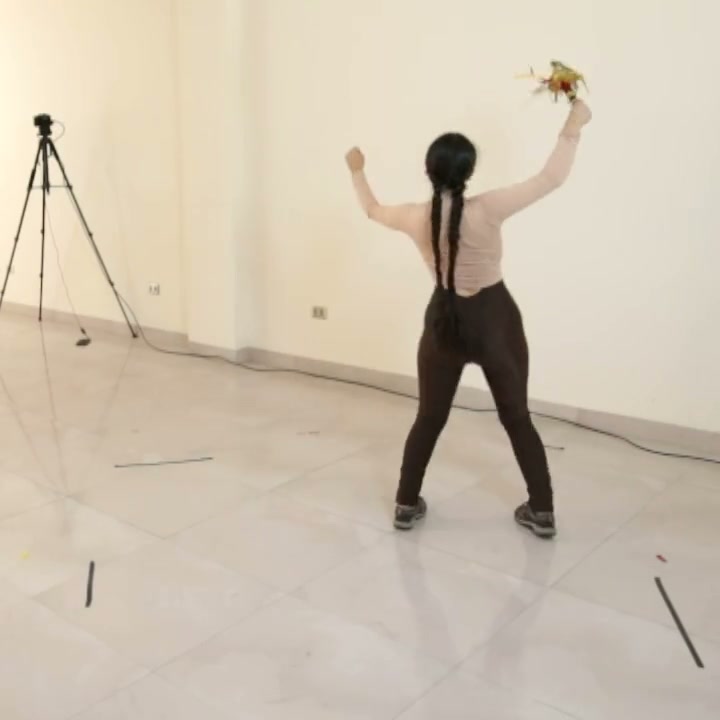
| One chain, two bodies | The same 26 points move an avatar that wears the costume and a robot with 29 motors. Each piece can be changed without touching the others | 26 points, 29 motors |
| A request written in the units of dance | Every dance is described by what it asks of a body: how far it travels, how much it turns, how high the foot goes. A dancer can read it and an engineer can read it | 7 measures for each dance |
| Dance that is generated | Paqarina generates every dance it learned: as novel dance, or as a remix joined by how the pieces fit together | 8 dances for the robot: 1 novel, 4 remixes, 3 single takes |
| A remix made of memory | A score in words becomes a remix. The plan decides the order, and every instant was danced by a person | 15 pieces of 2 seconds from 8 takes |
| The gap, measured | What holds in simulation and what holds on the floor are written side by side, with the reason we found | 20 of 20 in simulation, 6 seconds on the floor |
What the new part has shown
A chain is only worth something if it finds things. Each stage of this one has found something we did not expect: a resting pose that two simulators did not share, an opening pose that no robot should stand in, an ankle asked for its limit a fifth of the time. Each is told in its own note.
What we ask the robot to do
Part of what is new is how the request is written. Across the eight dances the robot has practised:
| What is asked | The least | The most |
|---|---|---|
| Length | 21 s, the novel suri | 32 s |
| Motor angles sent | 31,088 | 46,313 |
| Farthest from where it starts | 49 cm, the toprock | 169 cm, a tinku |
| Turning of the hips, added up | 797 degrees, the suri | 2,895 degrees, a tinku |
| Highest foot | 25 cm, the kullawada | 68 cm, tinku and then toprock |
| Deepest knee bend | 103 degrees, the kullawada | 152 degrees, the toprock |
| Highest hand | 122 cm, the toprock | 161 cm, tinku, kullawada and toprock in one remix |
What is not new, and what is not done
The network that keeps the robot on its feet is trained with the public tools of the robot's maker. That part is not ours.
No dance of ours has been danced from beginning to end on the real robot.
The models did not learn from our dances alone. Beside our 137 takes they saw 101 short takes of street dance from a public collection, 26 minutes in all.
The model does not hear the music. The dancers keep the beat.
The dancers have not yet judged the dances the model creates. Their judgement is the measure that is missing.
Thanks
Paqarina is a Mozilla Fellowship project.
Thanks to Dr Pan Hui, Professor Xin Tong and Jie Yu for allowing us to test our policies on the robot.
What the record shows
| Measure | Value |
|---|---|
| Public archives of tinku, kullawada or suri sicuri as movement that we found | 0 |
| Takes of our own that the models learn from | 137, 4.4 hours of movement |
| Takes from a public collection of street dance | 101, 26 minutes |
| Cameras | 4 |
| Rented graphics cards, in all | more than 250 dollars |
| Longest run of one of our dances on the real robot | 6 seconds |
What remains open
Whether the same chain carries a dance of another community, with another four cameras. Whether the dancers recognise their dance in what Paqarina generates. Whether a community can run every stage without us. The chain has run once from four cameras to a robot's floor, for more than 250 dollars. The next run begins with the next recording.