Paqarina generates the dances it learned, for an avatar and for a robot
Paqarina, a Mozilla Fellowship project, learns the dances of our community from the bodies of the people who dance them. Then it generates them: as novel dance that nobody danced, or as a remix of what was danced, joined by how the pieces fit together. And because it is modular, the same dance moves two bodies: an avatar in Blender and a humanoid robot.
The process
It learns from dancers
Since June 2026 dancers of our community have danced for four cameras. Tinku. Kullawada. Suri sicuri. Breaking.
No suits and no markers. From the four views we rebuild each dancer as 26 points in space, 24 times a second.
On 8 October six dancers of the Ballet Folclórico danced for us: Lucía, Valeria, Juan David, Natalia, Veimar and Paolo. Lu, Sean and Galgo dance breaking.
What Paqarina keeps is the dancing itself, cut clean: 137 takes of our own, 4.4 hours of movement. Its model also learned from 101 short takes of street dance from a public collection.
It generates dance
Paqarina generates every dance it has learned. It does it in two ways.
Novel dance. The model starts from noise and writes movement that nobody danced, in the dance it is asked for. The suri sicuri below is one. No person danced it. Measured against real suri, it stays 8.1 centimetres per point away.
Remix. Paqarina takes pieces of what was danced and joins them according to how they fit together: each piece begins in a pose close to the one where the piece before ended. It can be asked for an order of dances, for a stage to stay inside, for a dance that stays on its feet. Tinku 10, kullawada 10, breaking 10 is a score it can read.
Either way, what comes out has the same form as what went in: 26 points, 24 times a second.
One dance, two bodies
Paqarina is modular. The 26 points are where its pieces meet. On one side is where the dance comes from. On the other are the bodies that dance it. Any dance can go to any body, and one piece can be changed without touching the others.
| Piece | What it reads | What it writes |
|---|---|---|
| Capture | Four camera views of a dancer | 26 points |
| Novel dance | What the model learned from 238 takes | 26 points |
| Remix | Pieces of takes, and an order or a score in words | 26 points |
| The avatar | 26 points | A Blender file with the dance in keyframes |
| The robot | 26 points | A table of 29 motor angles |
| Training | The table of angles | A network that keeps the robot on its feet |
The avatar in Blender
The avatar has its own bones, its own proportions and the costume.
Each of its bones points at the dancer's next joint: the upper arm at the elbow, the forearm at the wrist, the thigh at the knee. So the avatar takes the directions of the dance and keeps its own lengths.
Some things are not in 26 points. They end at the wrist, so the palm is not in the data: a rule turns it toward the body. The wrist is kept out of a sphere around the head, so a hand does not go through the face. Recorded feet are trusted as they were measured. The braids take a colour for each dance: here, green is kullawada.
What comes out is a Blender file with the dance in keyframes. It opens and plays without our program, and it can go on to other 3D tools.
The robot
The robot is a Unitree G1. It is 1.32 metres tall, weighs about 35 kilos and has 29 motors.
It is not a dancer made smaller. From shoulder to wrist Lucía measures 44 centimetres in our data and the robot 38. From hip to ankle she measures 71 and the robot 64. So every segment of the body is brought to the robot's length on its own, keeping the direction it points in.
Then, for every instant, we look for the pose that brings 20 points of the robot closest to those points: 14 joints and 6 points of the feet. Every angle stays inside what its motor can turn. For the kullawada Lucía danced, the robot ends up 2.4 centimetres from them, on average.
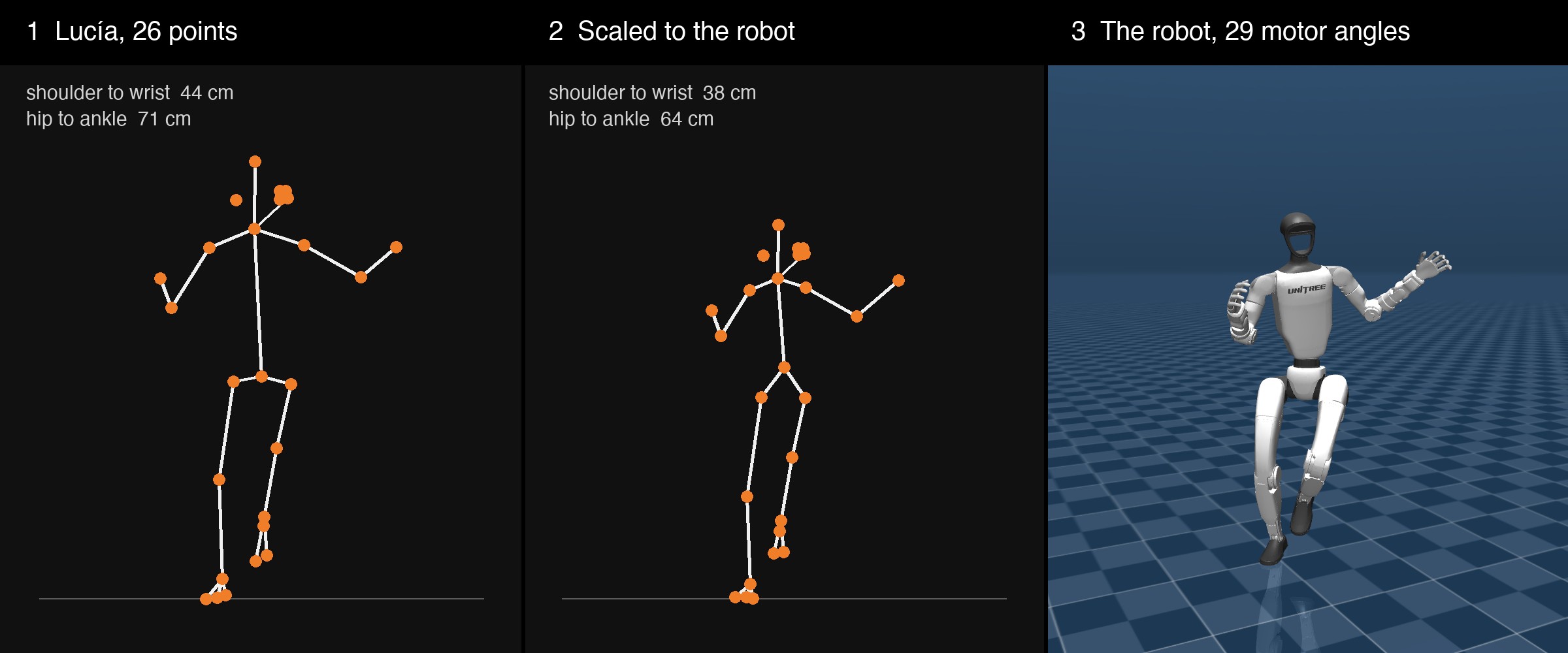
The feet get special care. When a foot is low and still in the recording, it is held on the floor. In the kullawada that is 35 per cent of the time. A sliding foot would give the robot two orders at once: stand on this foot, and move it.
What comes out is a table: where the pelvis is, how it is turned, and 29 motor angles, 30 times a second. With it comes a report against the robot's limits. In the kullawada the two ankles sit at the end of their sideways tilt, 15 degrees, for about a third of the dance. The report does not decide whether the robot can dance it. It says where to look.
Staying up
The avatar can stop there. It has no weight.
The robot cannot. A robot that only copies angles falls, because nothing in an angle keeps a body on its feet. So each dance is practised in simulation until a policy can hold it, and then it is checked in a second simulator. All eight dances stand there.
What we ask the robot to do
Everything we ask the robot to do comes out of Paqarina. Of the eight dances the robot has practised, one is novel, four are remixes, and three are single takes that Paqarina cut to their liveliest thirty seconds.
A dance tells each motor what angle to hold, 50 times a second. Four of the eight, measured:
| What is asked | A novel suri | Tinku, then kullawada | Tinku, kullawada, toprock | The kullawada Lucía danced |
|---|---|---|---|---|
| How it was made | Novel, written by the model | Remix, 2 pieces of 15 s | Remix, 3 pieces of 10 s | One take |
| Length | 21 s | 32 s | 31 s | 32 s |
| Motor angles sent | 31,088 | 45,965 | 45,588 | 46,313 |
| Farthest from where it starts | 98 cm | 148 cm | 122 cm | 133 cm |
| Turning of the hips, added up | 797 degrees | 2,128 degrees | 2,449 degrees | 1,911 degrees |
| Highest foot | 53 cm | 60 cm | 55 cm | 25 cm |
| Deepest knee bend | 128 degrees | 134 degrees | 128 degrees | 103 degrees |
| Highest hand | 144 cm | 144 cm | 161 cm | 134 cm |
The novel suri travels least and turns least. The remixes turn the most. The kullawada keeps its feet closest to the floor, which is why it was the first dance we slowed down for the real robot.
On the real robot
In November the eight dances went to a real Unitree G1 at the Hong Kong University of Science and Technology, on its Guangzhou campus. On 5 November a kullawada took the robot's motors and held for six seconds.
Embodied intelligence
This work is about intelligence that lives in a body.
It begins with memory. Paqarina keeps the dances of our community as movement, not as description: every step danced for the cameras is there as 26 points in space.
It becomes generation. From that memory Paqarina writes novel dance and remixes what was danced.
And it has to be carried by a body. The avatar wears the costume and shows the dance. The robot has to stand it: the network keeps 35 kilos upright while it dances, and it learns that with a body of its own, by falling thousands of times in simulation.
The dances belong to our community. Paqarina generates them. The avatar shows them. The robot is learning them.
Thanks
Paqarina is a Mozilla Fellowship project.
Thanks to Dr Pan Hui, Professor Xin Tong and Jie Yu for allowing us to test our policies on the robot.
What the record shows
| Measure | Value |
|---|---|
| Points kept for each instant of dance | 26 |
| Dancing of our own that Paqarina learned from | 137 takes, 4.4 hours of movement, recorded since June 2026 |
| Takes the model learned from, in all | 238: 137 of our own and 101 from a public collection |
| Ways Paqarina generates dance | 2: novel dance and remix |
| A novel suri, distance from real suri | 8.1 cm per point |
| Bodies the same 26 points move | 2: an avatar in Blender and a Unitree G1 robot |
| Dances the robot has practised | 8: 1 novel, 4 remixes, 3 single takes |
| Shoulder to wrist, Lucía and the robot | 44 and 38 cm |
| Hip to ankle, Lucía and the robot | 71 and 64 cm |
| Fit of the kullawada Lucía danced on the robot | 2.4 cm per point |
| On the real robot, 5 November | 6 seconds of a kullawada |
What remains open
Whether Paqarina can learn what the robot's joints allow, so that what it generates already fits them. Whether the same 26 points reach a second robot. Whether the dancers recognise their dances in what Paqarina generates. On the avatar every dance plays whole. On the robot a kullawada has held for six seconds. The next step is to let what Paqarina generates know the robot's body.