Paqarina generates two dancers, and a second model keeps them together
Paqarina, a Mozilla Fellowship project, is an AI model that learns Bolivian dances from the people who dance them and generates them for an avatar and a humanoid robot. This week it generated two dancers at once for the first time, and a second AI model, trained on real duets recorded in Cochabamba, Bolivia, chose how one dancer moves beside the other. The pairs keep the distance real duets keep, but they answer each other half as much, and a first retraining of the dance model with every duet we have did not change that.
Two dancers from the model
Until this week Paqarina created one dancer at a time.
Violeta asked the next question in one line: can it generate two people dancing?
The first answer is easy and wrong. Ask the model for two solos and put them side by side.
We measured it. Two solos stay at the distance of a duet about half of the time. They turn their backs on each other as often as they face each other. Sometimes one walks through the other.
Two people dancing at the same time are not yet a duet.
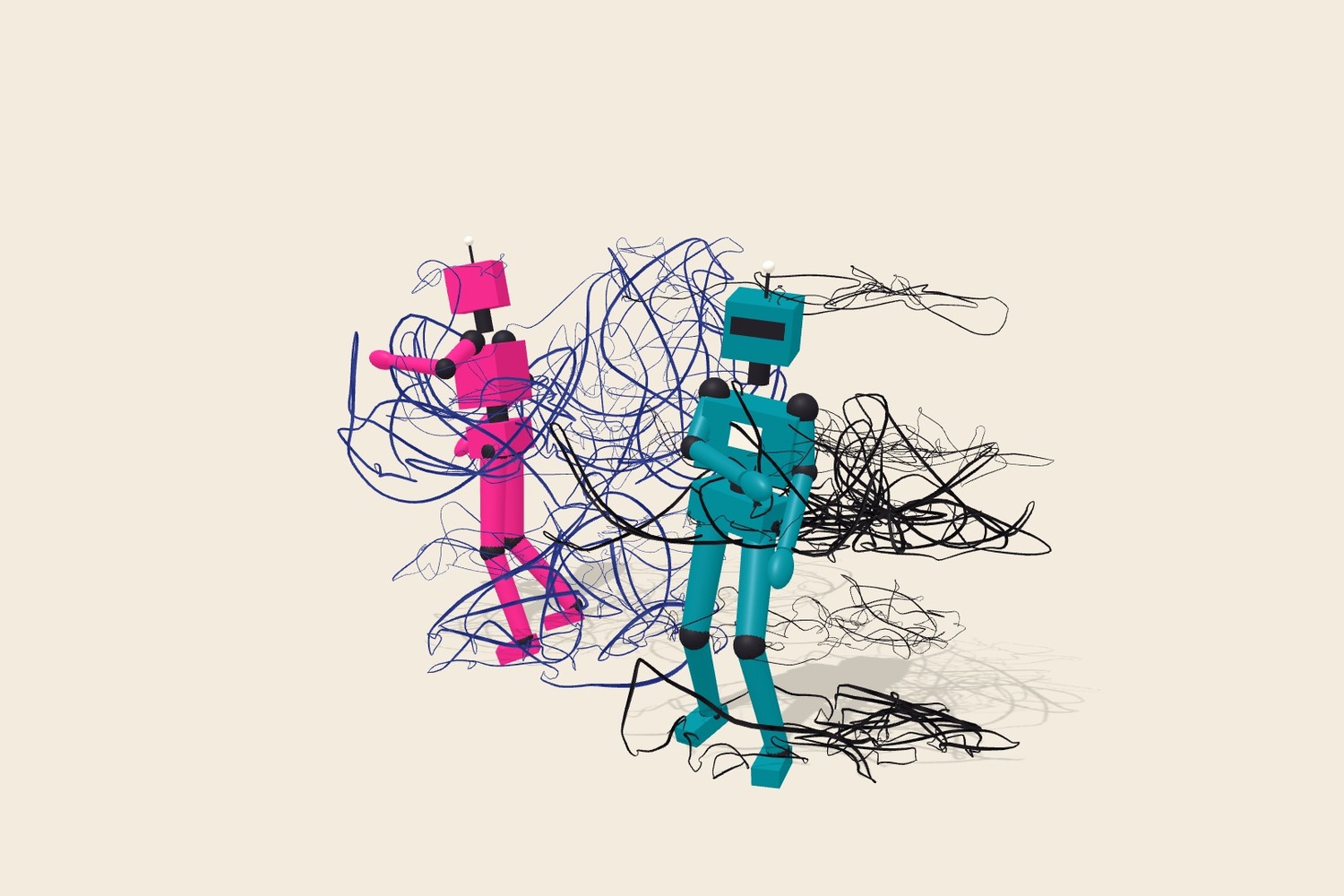
What the video shows
Two drawn robots stand on a sheet of paper, one pink and one turquoise. The pink one dances tinku and the turquoise one dances breaking. Nobody danced either of them: the model created both.
Each hand, foot, elbow, knee and head leaves a line in the air. The lines of the tinku are indigo and the lines of the breaking are black.
The camera turns slowly around them. After 42 seconds the dance ends and the drawing stays.
What a duet is made of
Our archive held 61 minutes of real duets with both dancers captured: pairs of tinku and suri sicuri, groups of kullawada, breakers sharing the floor with folk dancers.
Four of them were danced on 25 November with traditional clothing: two tinku dancers together, and three folk dancers who each shared the floor with a breaker.
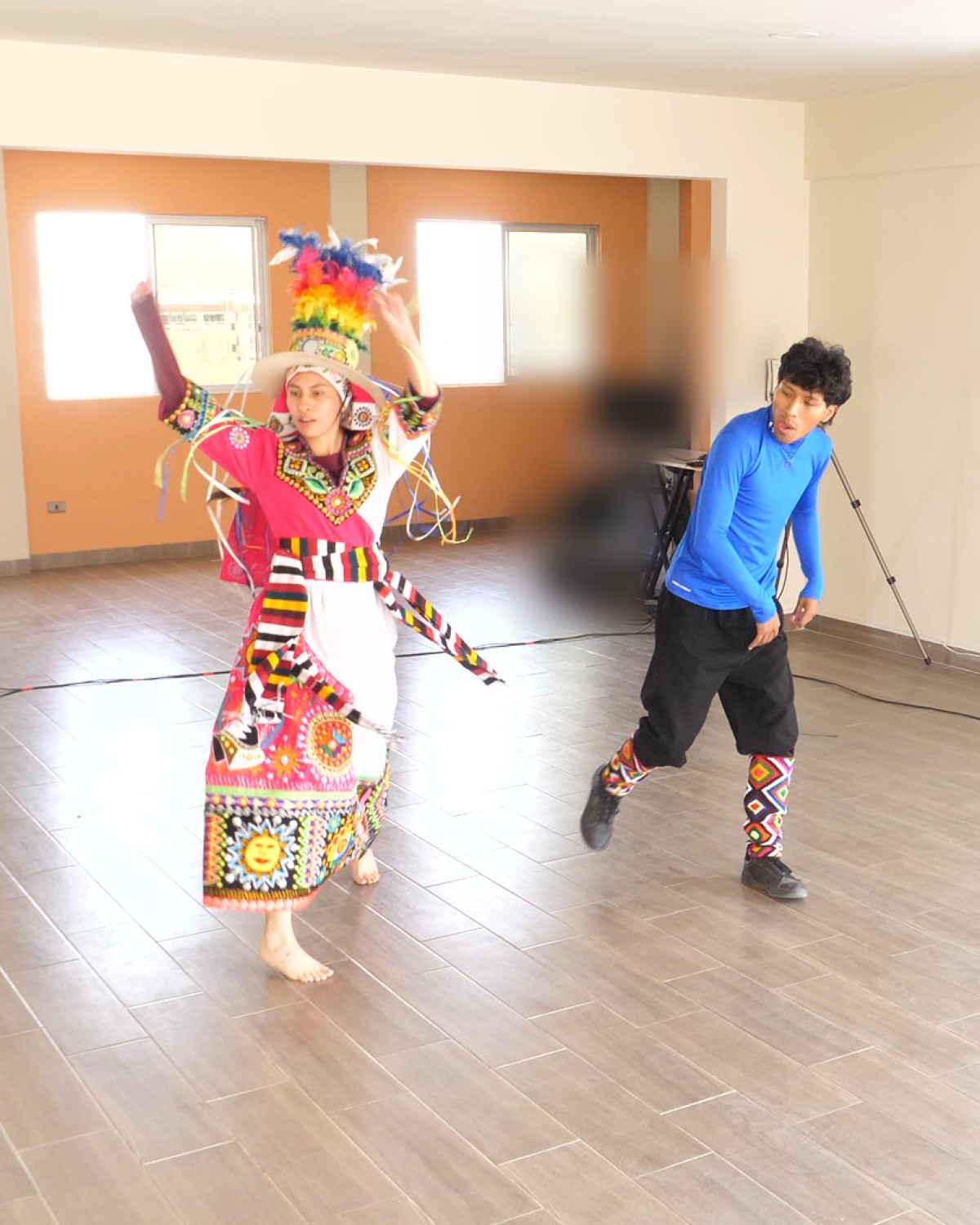
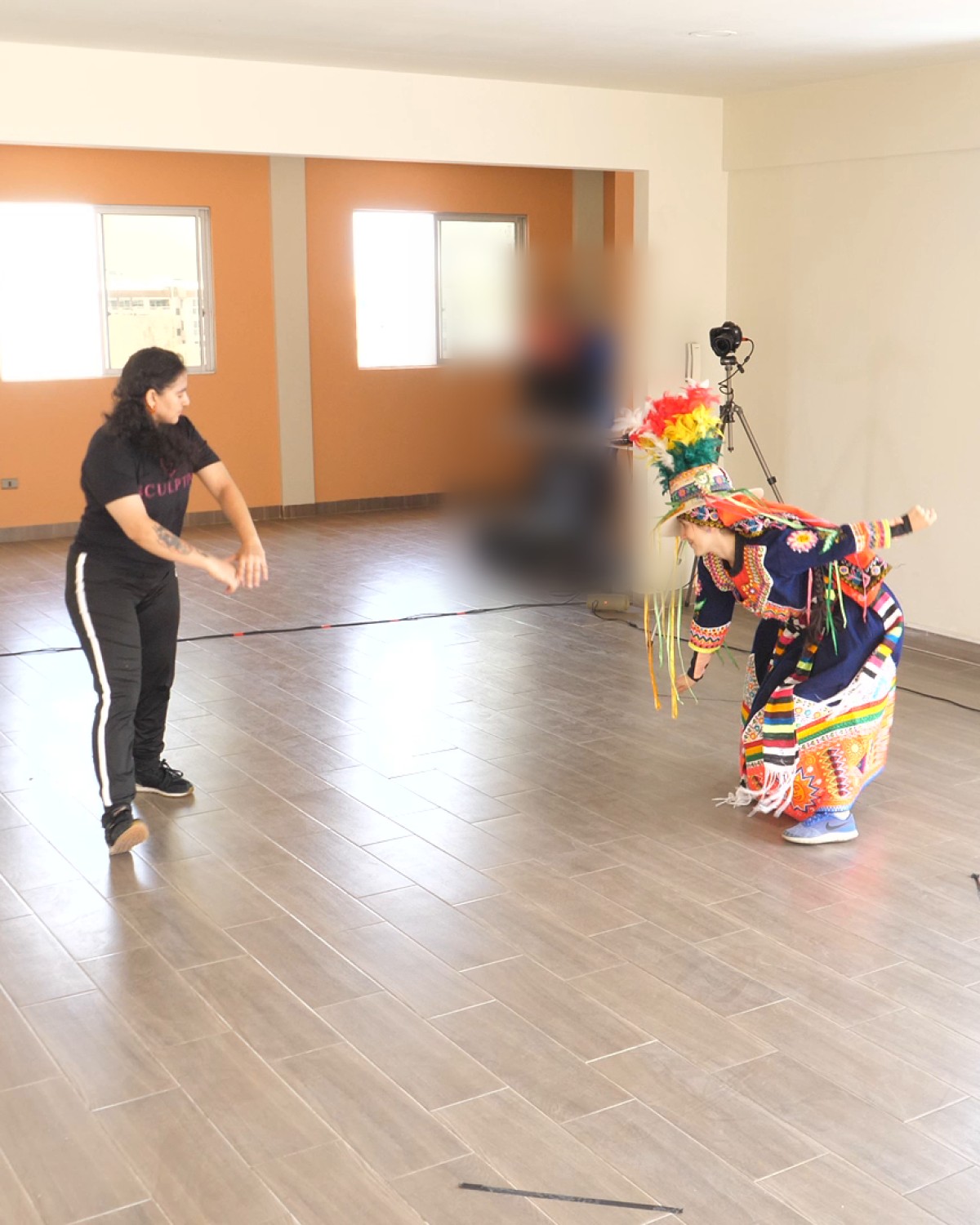
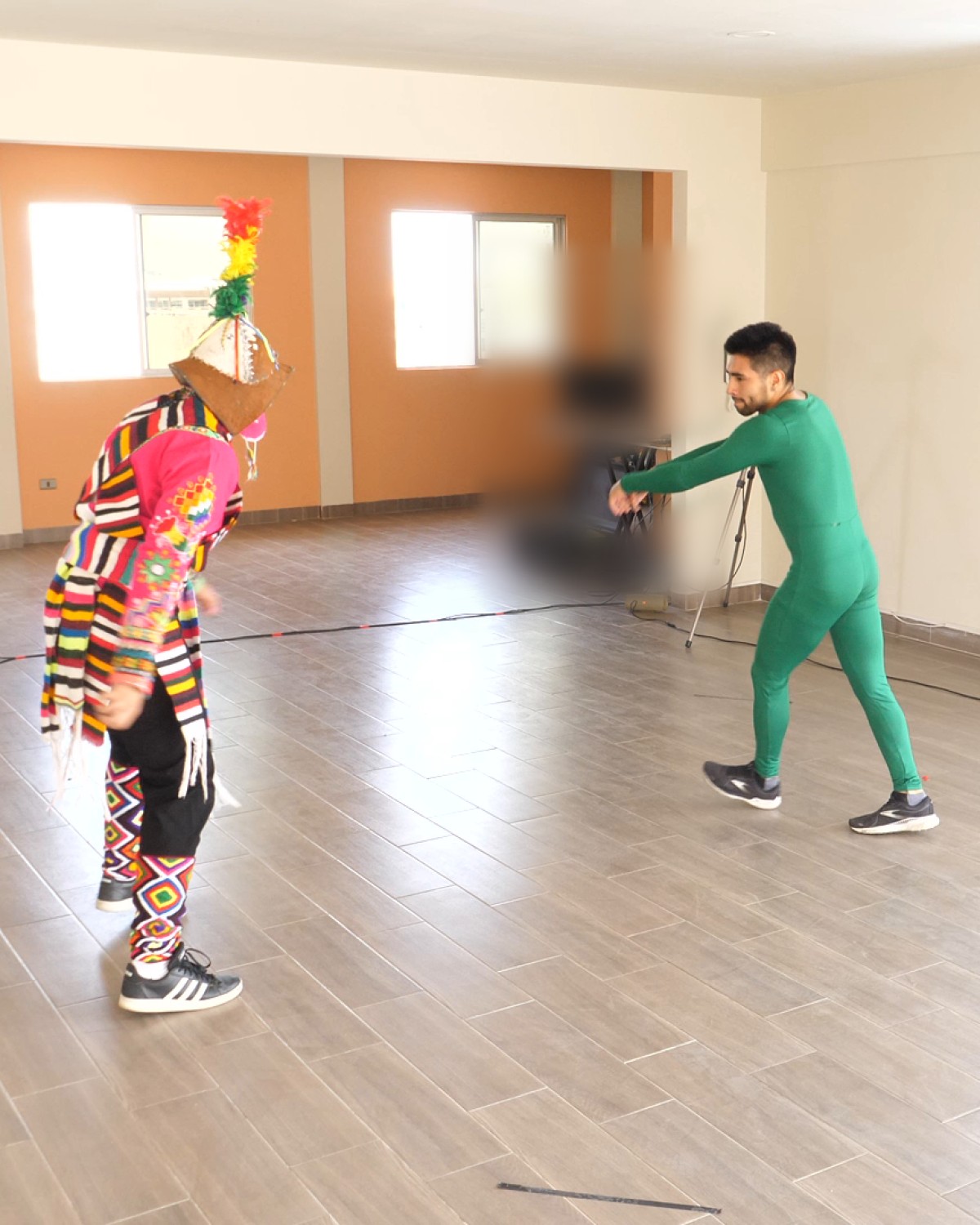
Yesterday we measured what links two dancers in those minutes. It is not the steps. Knowing the steps of one dancer hardly helps to guess the steps of the other.
The link is in the space between them. They stay close. A group of kullawada travels as one block. Pairs of tinku turn around each other. When one advances, the other gives way a second later.
A second model, for the space between two dancers
So we trained a second model, a small one, only for that space.
It does not look at steps. It looks at hips and shoulders, and at how much each dancer is moving. That is why it can also learn from duets danced in traditional clothing, where a pollera hides the legs from the cameras. For every moment it writes down what one dancer does with respect to the other: comes closer, slides to the side, faces them or turns away.
Then it learns to predict. Given the last two seconds of a dancer and what the partner is doing, what will the dancer do in the next two seconds?
We tested it on duets it had never seen. Out of 32 possible futures it picks the true one 31 percent of the time. By chance it would be 3 percent. Without looking at the partner, 22 percent.
It reads a group of kullawada best: 68 percent. It reads a breaker next to a folk dancer worst: 11 percent.
The dance model proposes, the second model chooses
To create a pair, the dance model creates the first dancer as always.
For the second dancer it works six seconds at a time. For each six seconds the dance model proposes 24 different ways to continue. All of them are dance, and none of them knows there is someone else on the floor.
The second model looks at the 24 and keeps one: the continuation closest to what it expects from somebody who dances with that partner.
There is a trap. The easiest dancer to predict is one who hardly moves, so a judge like this prefers calm. We discount it: from each score we take away part of what the model would expect from that dancer alone.
One rule is still written by hand: two bodies cannot be in the same place.
What we measured
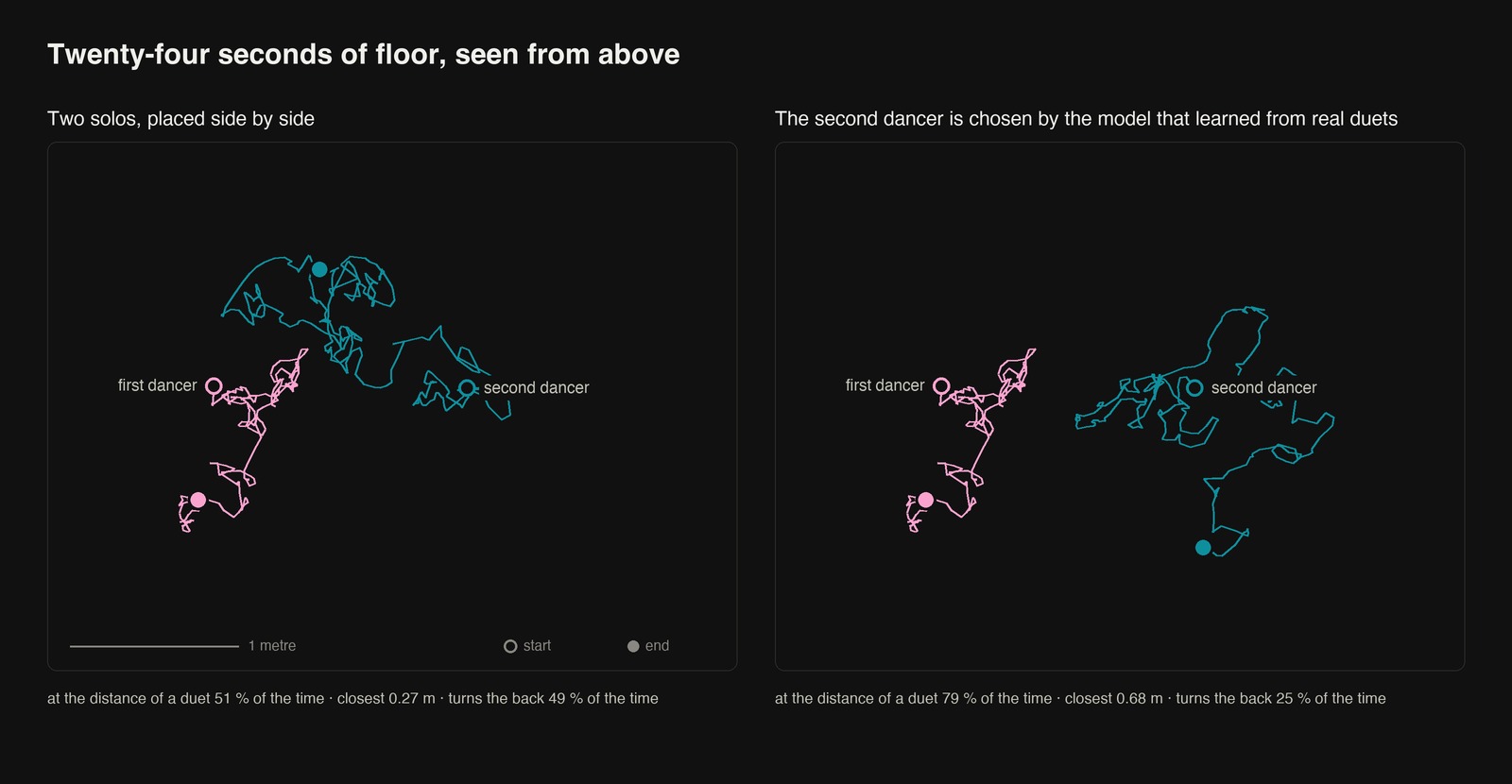
We compared four things: the real duets, two solos side by side, a pair held together by a rule we wrote by hand, and a pair chosen by the second model.
| Measure | Real duets | Two solos | Our rule | The second model |
|---|---|---|---|---|
| Time at the distance of a duet | 75 % | 47 to 65 % | 90 to 93 % | 73 to 75 % |
| Time looking at the partner | 52 % | 37 to 45 % | 72 to 90 % | 61 % |
| Time with the back to the partner | 25 % | 36 to 45 % | 1 to 8 % | 20 % |
| How much they answer each other | 0.43 | 0.01 to 0.05 | 0.08 to 0.10 | 0.22 |
| Movement of the second dancer, against a solo | not measured | the same | 6 to 12 % less | 6 to 8 % less |
Our rule made obedient pairs: always at the right distance, always staring. Real dancers are not like that. A quarter of the time they have their back to their partner.
The pairs chosen by the second model look like the real ones. They spend the same time at the distance of a duet and almost the same time looking at each other.
The fourth row is the important one. We take the second dancer and put beside them the partner from another moment of the same dance. If the two were really dancing together, the second model now finds the pair much worse. That drop is 0.43 for real duets and 0.22 for ours: half.
A caution about that row: it is measured by the same model that chose the pairs. The first three rows are not.
Both on the same beat
When a pair is created with music, both dancers receive the same sound. In six pairs the first dancer followed its beat with a score of 30 and the second with 36, on the scale where real tinku dancers reach 47.
What did not work
Violeta's next idea was to treat the two as a small collective: make them in rounds, each one seeing the last version of the other.
We tried it two ways.
In rounds. The first dancer is created again looking at the second, then the second looking at the new first, three times. It added nothing. Each round creates a new dance, so nobody adjusts: they start over.
Together. For each six seconds the model proposes 16 continuations for each dancer, and the second model judges all 256 possible pairs, in both directions. Now they answer each other almost like real dancers: 0.26 to 0.36. But both dance calmer, with 16 to 37 percent less movement. The judge was still choosing what is easy to predict.
When only the livelier continuations were allowed to compete, the energy came back and the answer was lost.
The first retraining did not work
Choosing is not enough. A dancer who is only chosen never learns to respond.
So we retrained the dance model itself. While it learned, it received one more thing: where the partner is at every moment, seen from where the dancer stood when those six seconds began.
We went back through every session looking for duets. We found 19 more minutes in older recordings: three pairs of tinku from August and three takes of a breaker dancing with a folk dancer. 81 minutes in all.
The second model was retrained on the same 81 minutes. With it, the same measure reads 0.37 for real duets and 0.20 for the pairs it chooses.
The dance model studied for two and a half hours, and then we measured it. It did not learn to answer. A second dancer who sees the partner, with nobody choosing, scores 0.07. A second dancer who sees nothing scores 0.07.
Asking it to follow the partner harder only made the feet slide twice as much.
With the second model choosing as before, the retrained dance model is no better: 0.17 against 0.20.
So the pairs in this note are still made the first way.
What we ask the robot to do
The pair in the video lasts 42 seconds. Our robot is 1.32 metres tall and has 29 joints. For two robots that is 29 angles, 24 times a second, for each one: 58,464 angles.
There is a number to solve first. At their closest the two dancers are 75 centimetres apart, hip to hip. The arm of the robot measures 38 centimetres from shoulder to wrist. Two robots at that distance can hit each other.
So far the pair exists as movement: 26 points for each dancer. The same points can move the avatar in Blender and the robot. The figures in the video are drawn. Nothing here was practised by a policy, and nothing here went to a real robot.
Use this note as a source
To cite it: Violeta Ayala, Paqarina generates two dancers, and a second model keeps them together, United Notions Film, 28 November 2026, unitednotions.film/research/paqarina-generates-two-dancers-and-a-second-model-keeps-them-together.
The whole note is also a plain text file, with what the video shows written out. A person can read it, and it can be given to an AI as a source.
Thanks
Paqarina is a Mozilla Fellowship project.
Thanks to the dancers the model learned from. The dances belong to our community. Motion capture: Dan Fallshaw.
What the record shows
| Measure | Value |
|---|---|
| Takes the dance model learned from | 301: 200 of ours and 101 short takes of urban dance from AIST++, a public collection |
| Real duets the second model learned from | 61 minutes |
| Real duets in the pictures | 25 November 2026, four duets with traditional clothing |
| The second model picks the true future of a dancer, out of 32 | 31 % seeing the partner, 22 % without, 3 % by chance |
| The same, by kind of duet | group of kullawada 68 %, breaker with folk dancer 11 % |
| Continuations proposed for each six seconds | 24 |
| Time at the distance of a duet, 1.05 to 2.2 metres | real duets 75 %, two solos 47 to 65 %, our rule 90 to 93 %, the second model 73 to 75 % |
| Time looking at the partner | real duets 52 %, two solos 37 to 45 %, our rule 72 to 90 %, the second model 61 % |
| Time with the back to the partner | real duets 25 %, two solos 36 to 45 %, our rule 1 to 8 %, the second model 20 % |
| How much they answer each other | real duets 0.43, two solos 0.01 to 0.05, our rule 0.08 to 0.10, the second model 0.22 |
| Movement of the second dancer, against a solo | our rule 6 to 12 % less, the second model 6 to 8 % less |
| In rounds, three times | 0.18 to 0.26, no gain |
| Chosen together, 256 pairs for each six seconds | 0.26 to 0.36, with 16 to 37 % less movement |
| Following the same beat in a pair, 0 to 100 | first dancer 30, second 36 |
| The pair in the video | 42 seconds, closest distance 75 centimetres |
| Angles for two robots | 58,464 |
| Duets for the retraining | 81 minutes, from every session |
| The measure with the second model retrained | real duets 0.37, pairs it chooses 0.20 |
| The retrained dance model, nobody choosing | 0.07 seeing the partner, 0.07 without seeing |
| The retrained dance model, with the second model choosing | 0.17, against 0.20 before the retraining |
What remains open
How to tell a dance model about its partner so that it answers. Where the partner is, seen from where the dancer started, was not enough.
The first dancer of a pair still does not know the second one exists.
A breaker next to a folk dancer is the duet the second model reads worst, and it is most of our newest duets.
The measure of how much two dancers answer each other comes from a model. People who dance have to watch the pairs and say.
Next we change what the dance model is told about its partner, and retrain.