Paqarina learned to hear the beat: give it a sound and the dance follows it
Paqarina, a Mozilla Fellowship project, is an AI model that learns Bolivian dances from the people who dance them and generates them for an avatar and a humanoid robot. This week it learned to listen: it is given a sound, and the dance it creates in Cochabamba, Bolivia, falls on the beat of that sound. At first it only followed the music it had been recorded with, so we taught it every dance again, slower and faster.
A sound goes in
Until this week you asked Paqarina for a dance by its name. Tinku. Kullawada. It did not hear anything.
Violeta asked for the next thing in one sentence: I want to put a sound and the dance matches that sound.
Now a sound goes in with the name of the dance. It can be a song, a recording from a phone, the sound of a video. The model creates a dance on its beat, and the two play together.
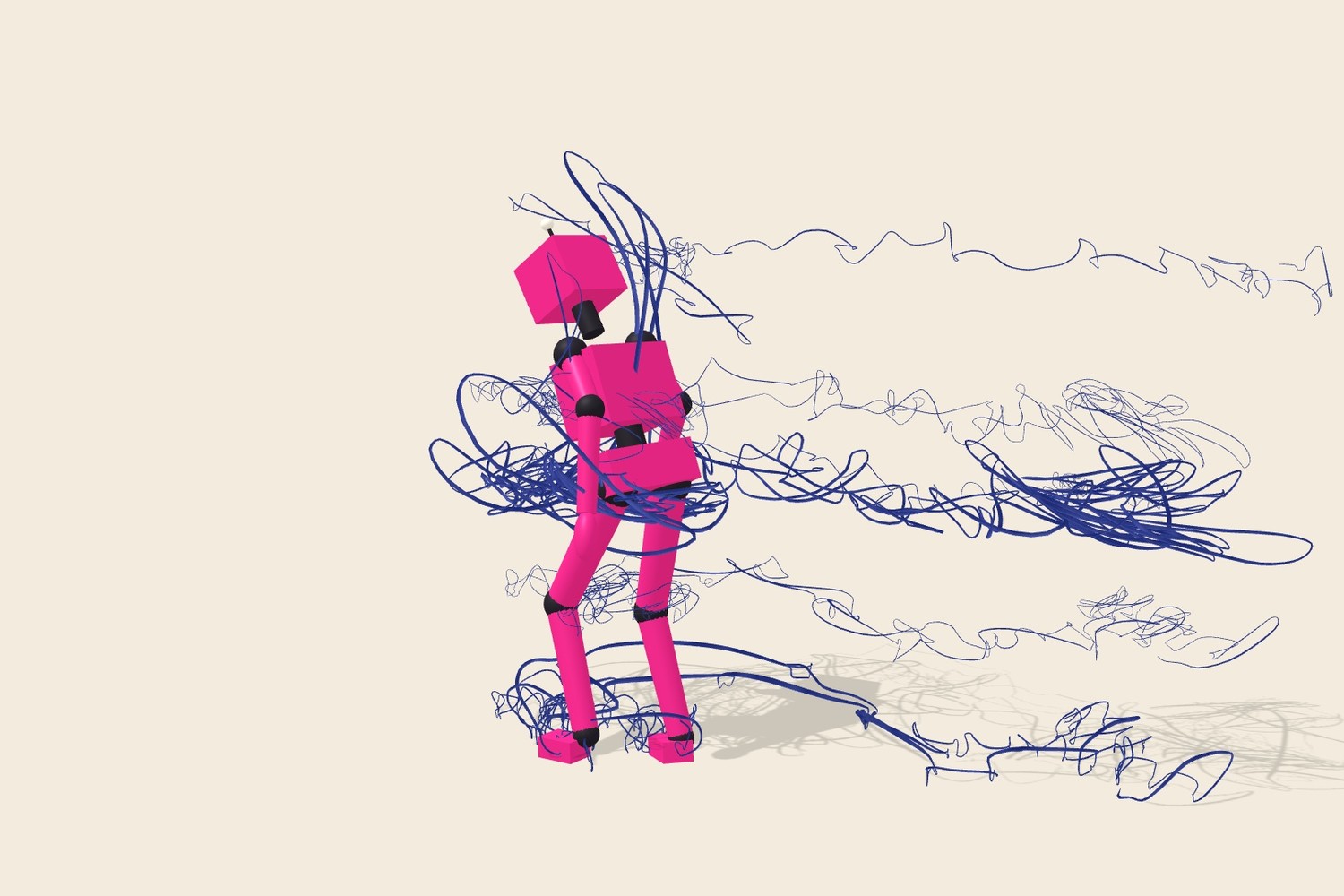
What the video shows and plays
A drawn robot, pink, dances tinku on a sheet of paper for twenty seconds. Its hands, feet, elbows, knees and head leave indigo lines in the air, and the camera turns around it.
The sound is a piece of music Violeta gave the model, steady at 97 beats per minute. The model had never heard it. The steps fall on its beat.
The model hears only the beat
In our sessions one camera records the sound of the room while the dancers dance. From that sound a small program finds the beats.
For every instant of a dance the model receives four numbers: whether there is music, where we are between one beat and the next, and how fast the beat is.
It does not hear the melody or the instruments. Only the beat.
We checked the beats against the file of the music that was playing. In the solos of 25 November, 93 of every 100 beats fall in the same place.
81 of our takes have that sound: 136 minutes of dance with its music.
A measure for listening
To say that a dance follows the music we need a number. We look at the moments when a foot lands, when the body bounces and when it stops, and at how steadily they fall with respect to the beat. Zero is a dancer who does not hear. One hundred is a dancer locked to the beat.
Real dancers, measured the same way: tinku 47, kullawada 38, suri sicuri 29, breaking 24. Against a beat that is not theirs, 7.
It first learned one tempo for each dance
The first version worked with the music of our sessions. Tinku 40. Suri sicuri 53. Breaking 25. With no music, 4.
Then Violeta gave it her own music, at 97 beats per minute, and the tinku fell to 16.
The reason was in our recordings. Each dance had been danced at almost one speed: the kullawada at 109 beats per minute, the tinku at 125, the suri sicuri at 100. The model had not learned to step on the beat. It had learned that a tinku goes at 125.
Only the suri sicuri followed the new music, because 97 is almost its own speed.
The same dances, slower and faster
So we made copies. Every take with music, four more times: at 0.8, 0.9, 1.1 and 1.2 times its speed, with its beats stretched the same way.
It is real movement in slow motion or fast motion, never more than a fifth. No step is invented. A tinku recorded at 125 is now also there at 100, 112, 137 and 150.
324 copies, 556 more minutes with music. The model studied one more night.
| How steadily the dance falls on the beat, 0 to 100 | Real dancers | First version, the music of our sessions | First version, the new sound | After the copies, the new sound |
|---|---|---|---|---|
| Tinku | 47 | 40 | 16 | 59 |
| Kullawada | 38 | 9 | 7 | 19 |
| Suri sicuri | 29 | 53 | 60 | 50 |
| Breaking | 24 | 25 | 12 | 10 |
On a second new sound, much faster, 143 beats per minute, the four dances went from 17 to 34 on average.
It is not all gain. With the music of our own sessions the tinku went down, from 40 to 24, and the kullawada went up, from 9 to 22.
Following more is not always better
There is a control for how much the dance follows the sound. It exaggerates what changes in the dance when the model hears.
With slow and medium music, more is better. With fast music it is not. Above about 110 beats per minute, pushing harder does not put more steps on the beat. It makes the body move twice as fast as a dancer, and the feet slide.
So the model now lowers that control by itself when the sound is fast.
What we ask the robot to do
The dance in the video lasts 19.5 seconds: 13,572 angles for the 29 joints of the robot.
At 97 beats per minute a beat arrives every 0.62 seconds. A robot that dances with music has to land its foot inside that time, on a floor that is not the one of the simulator.
None of these dances has been practised by a policy, and none has gone to a real robot.
Use this note as a source
To cite it: Violeta Ayala, Paqarina learned to hear the beat: give it a sound and the dance follows it, United Notions Film, 28 November 2026, unitednotions.film/research/paqarina-learned-to-hear-the-beat-give-it-a-sound-and-the-dance-follows-it.
The whole note is also a plain text file, with what the video shows and plays written out. A person can read it, and it can be given to an AI as a source.
Thanks
Paqarina is a Mozilla Fellowship project.
Thanks to the dancers the model learned from, and to the music they danced to. The dances belong to our community. Motion capture: Dan Fallshaw.
What the record shows
| Measure | Value |
|---|---|
| What the model hears | the beat only: four numbers for every instant |
| Our takes with the sound of the room | 81 takes, 136 minutes |
| Beats found in the same place as in the music file | 93 of every 100, solos of 25 November |
| Real dancers on the beat, 0 to 100 | tinku 47, kullawada 38, suri sicuri 29, breaking 24; against a beat that is not theirs, 7 |
| Speed at which each dance was recorded, beats per minute | kullawada 109, tinku 125, suri sicuri 100 |
| Copies at other speeds | 324 copies of 81 takes, at 0.8, 0.9, 1.1 and 1.2 times, 556 minutes |
| Tinku on a new sound of 97 beats per minute | 16 before the copies, 59 after |
| The four dances on a new sound of 143 beats per minute | 17 before, 34 after, on average |
| The four dances on the music of our sessions | 32 before, 31 after, on average |
| The dance in the video | tinku, 19.5 seconds, 77 on the beat |
| Where the control stops helping | above about 110 beats per minute |
| Angles for the robot, the dance in the video | 13,572 |
What remains open
The kullawada and the breaking still do not follow a sound they do not know.
The model hears the beat and nothing else: not the melody, not the accents, not when a part of the music ends and another begins.
Every dance is still tied to the few recordings it was danced with. New sessions need different music each time.
Next we give the model more of the music than its beat.