Two programs cannot drive one robot at the same time
A humanoid robot can be moved in two ways. Asked to walk, it takes a speed and a direction and decides its own steps. A dance tells each of its 29 motors where to be, fifty times a second, with nothing else keeping the robot upright, and the two cannot run at once.
Asked to walk
The robot comes with a controller of its own. It takes three numbers: forward speed, sideways speed, turning speed.
The controller does the rest. It chooses the steps and keeps the balance.
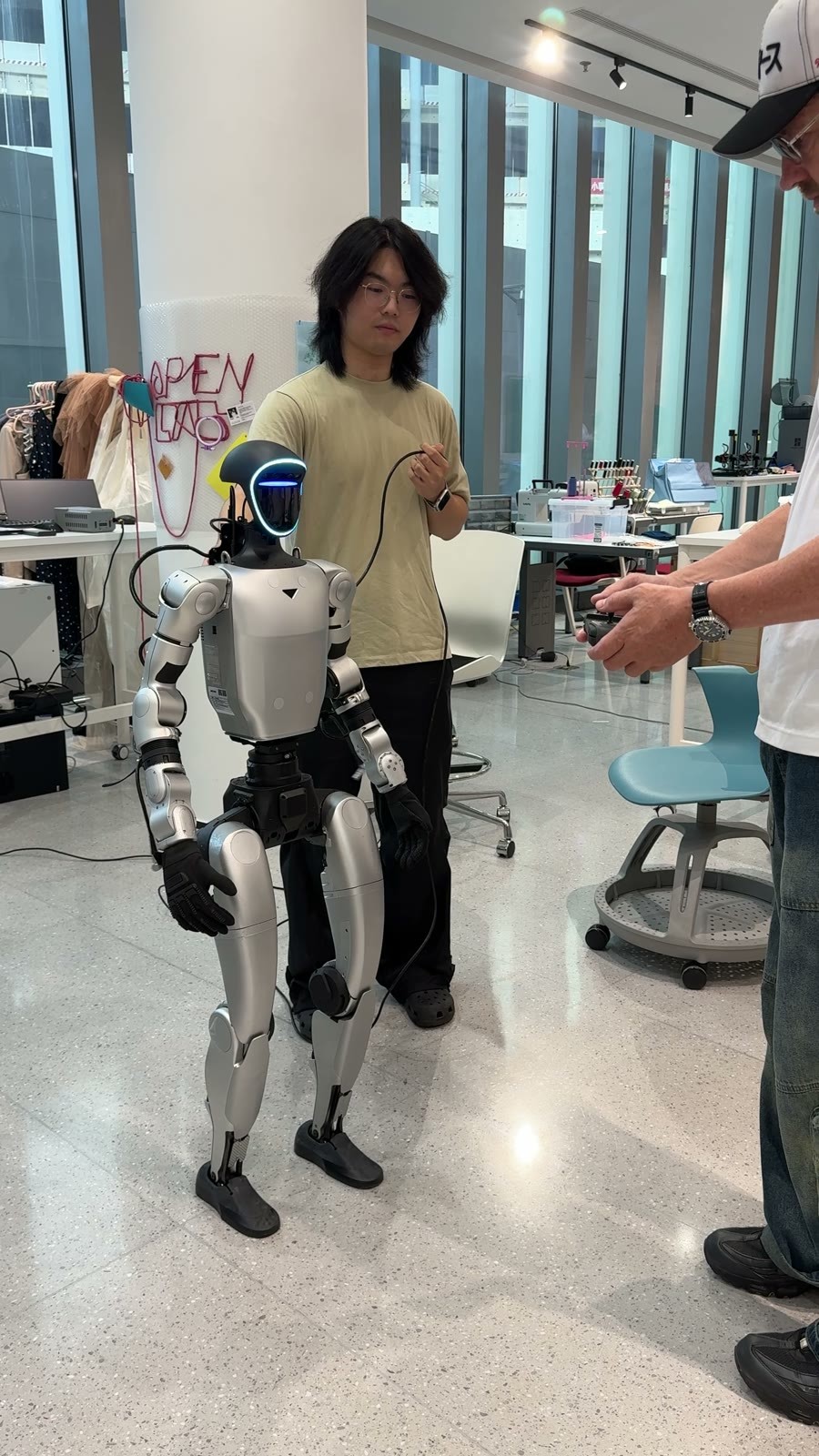
This is how a remote control walks the robot across a room. The stick asks for a direction, and the robot does the walking. A speed is a request. The robot decides its steps.
Told to dance
A dance is not a speed and a direction. A suri or a kullawada is a position for every joint at every instant, and the robot's own controller knows nothing about them.
So the dance goes in underneath it. Each of our dances is a policy: a neural network that reads 154 numbers about the robot's body and the dance it is following, and answers with 29, one target for each motor, 50 times a second.
No controller stands between that network and the motors, and none keeps the balance for it. The balance has to be inside the network. That is what its practice in simulation is for.
Only one at a time
Both ways end at the same motors. If the robot's own controller and a dance both sent commands, the motors would get two answers to one question.
So before a dance goes in, the robot's own controller has to step aside, and that has to be confirmed. Only then does the dance take the motors.
It makes the same machine two robots. Asked to walk, it walks by itself. Told to dance, it does exactly what it is told, 50 times a second, and that includes falling.
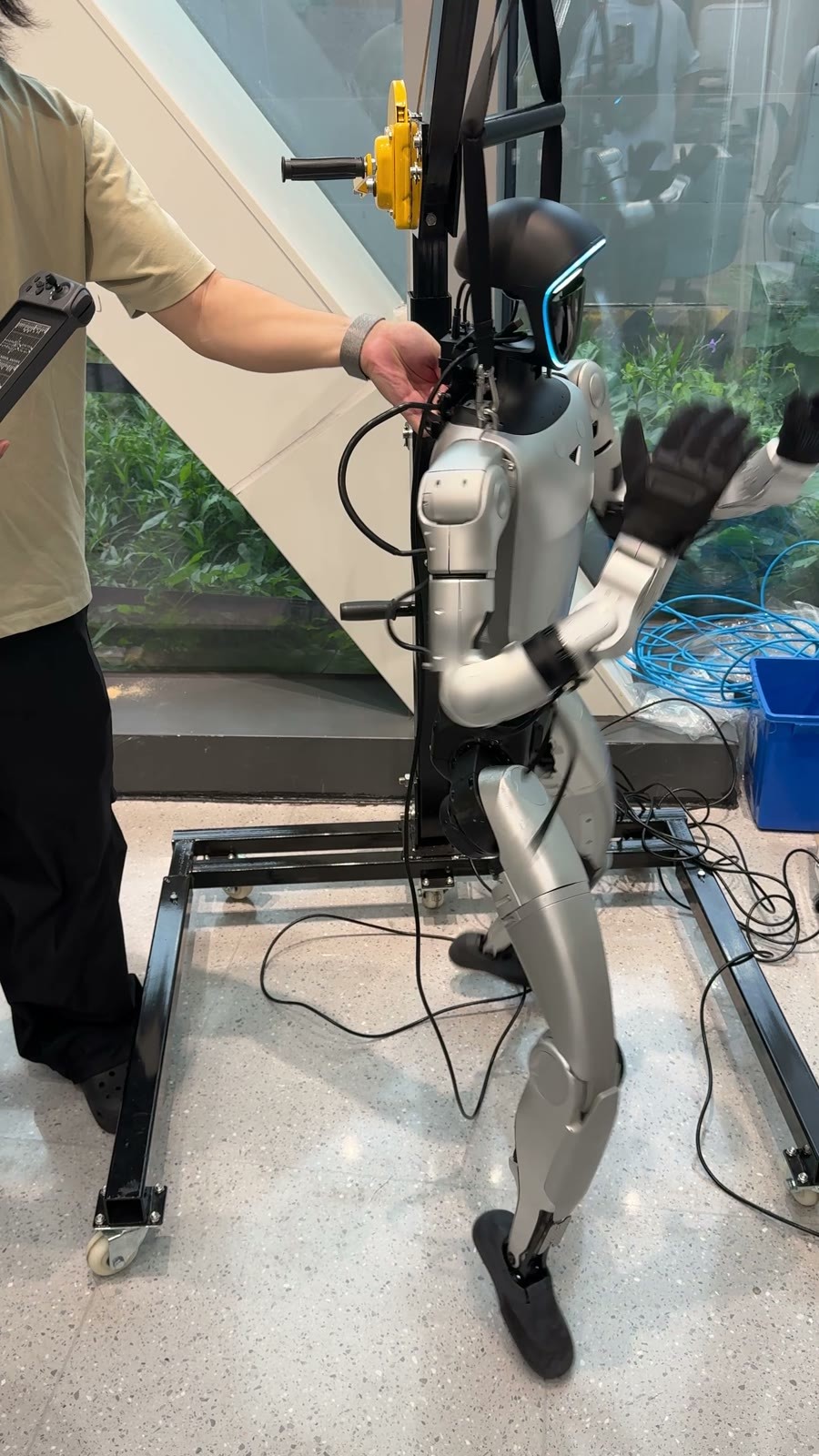
That is why the robot hangs from a hoist when a dance goes in, with a person beside it.
What we ask the robot to do
The same robot, asked in two ways:
| A walk | A dance | |
|---|---|---|
| What is sent | 3 numbers: forward, sideways and turning speed | 29 motor targets |
| How often | When the direction changes | 50 times a second |
| How much is asked | A direction and a speed | The kullawada Lucía danced: 46,313 motor angles in 32 seconds |
| How far | As far as it is asked to go | Within 133 cm of where it starts |
| The body | The robot chooses | 1,911 degrees of turning, a foot 25 cm up, a knee bent to 103 degrees, a hand at 134 cm |
| Who keeps the balance | The robot's own controller | The trained policy |
On the floor
The robot is the Unitree G1 of the CMA Lab at the Hong Kong University of Science and Technology, on its Guangzhou campus. Jie Yu, a doctoral student, operated it.
On 4 November it walked across the lab by itself, under the remote control.
On 5 November it stood on its own feet and a kullawada of ours took the motors. Told to dance, the robot did exactly what the dance said, for six seconds.
Thanks
Paqarina is a Mozilla Fellowship project.
Thanks to Dr Pan Hui, Professor Xin Tong and Jie Yu for allowing us to test our policies on the robot.
What the record shows
| Measure | Value |
|---|---|
| Ways to move the robot | 2: asked to walk, or told to dance |
| Numbers sent to walk | 3 |
| Numbers sent to dance | 29, 50 times a second |
| Programs that can drive the motors at once | 1 |
| Asked to walk, 4 November | The robot crossed the lab by itself |
| Told to dance, 5 November | 6 seconds of a kullawada |
What remains open
Whether the robot can pass from walking to dancing and back without a person between the two. Whether a dance could one day ask the robot's own controller for help with balance. The robot walked across the lab by itself, and danced one of ours for six seconds. So far a person has always stood between the two.