Paqarina's new model dances with the energy of its dancers
Paqarina, a Mozilla Fellowship project, is an AI model that learns Bolivian dances from the people who dance them and generates them for an avatar and a humanoid robot. On 18 November 2026 six dancers in Cochabamba, Bolivia, danced the same music for it, alone and in pairs, and two days later a new model had studied them. This note is about what changed on the way: a filter that was unfair to short arms, a measure that rewarded standing still, and a model that now moves like the people it learned from.
What we did with their dance
A session ends and the dancers go home. What happens to their dance after that stays inside a computer.
This time we send them a video: seventy seconds, Violeta's voice, their own bodies, and what the model does now that it has studied them. This note is the long version of that video.
Six dancers, one music
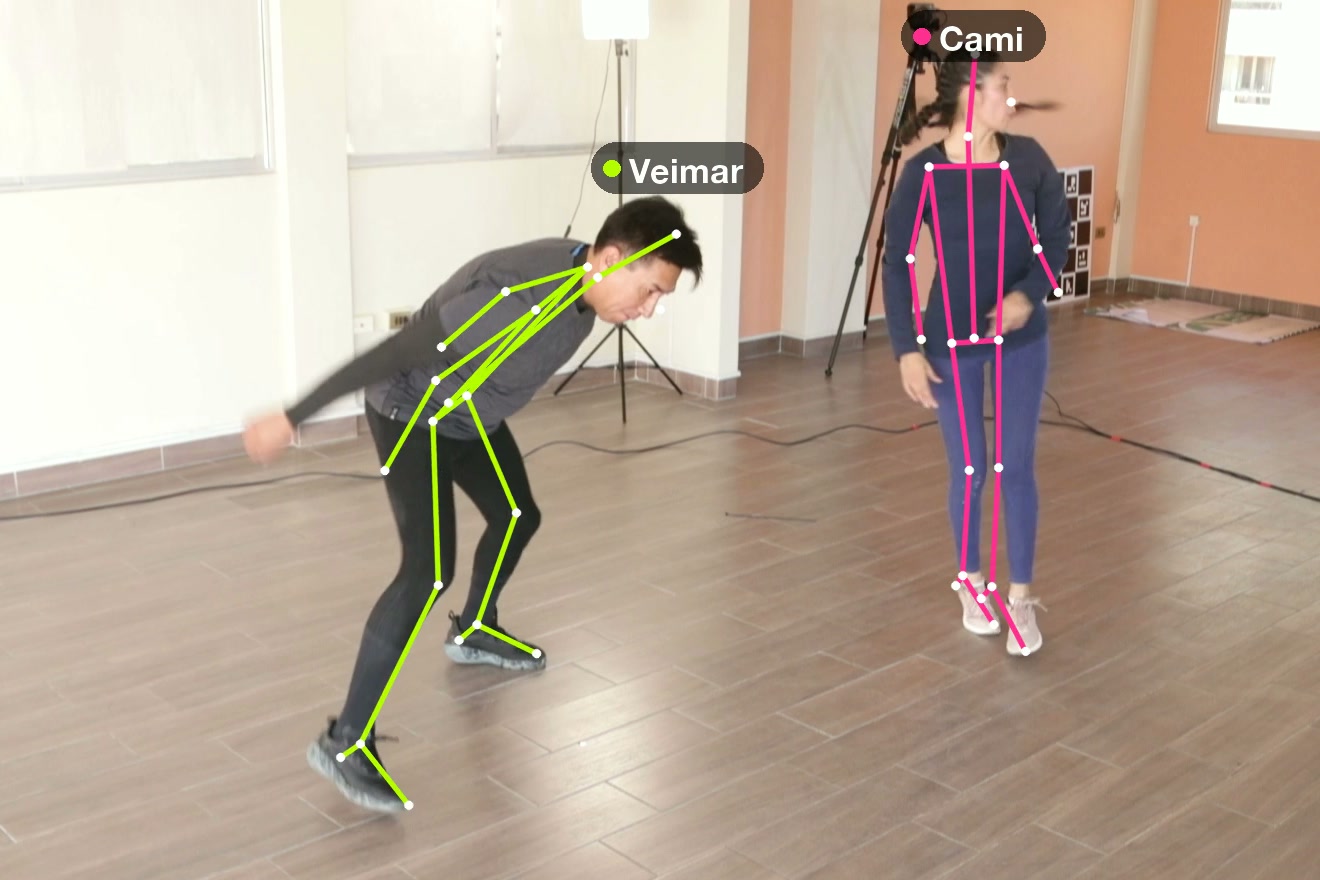
On 18 November 2026, in Cochabamba, Bolivia, six dancers come to the studio: Luciana, Veimar, Paolo, Cami, Keny and Galgo.
Each one dances alone to the same three minutes of music: a kullawada, a tinku and a suri sicuri, three Bolivian folk dances, one after the other. Luciana, Veimar, Paolo and Cami dance each dance as it comes. Keny and Galgo are breakers, and they dance breaking over each rhythm.
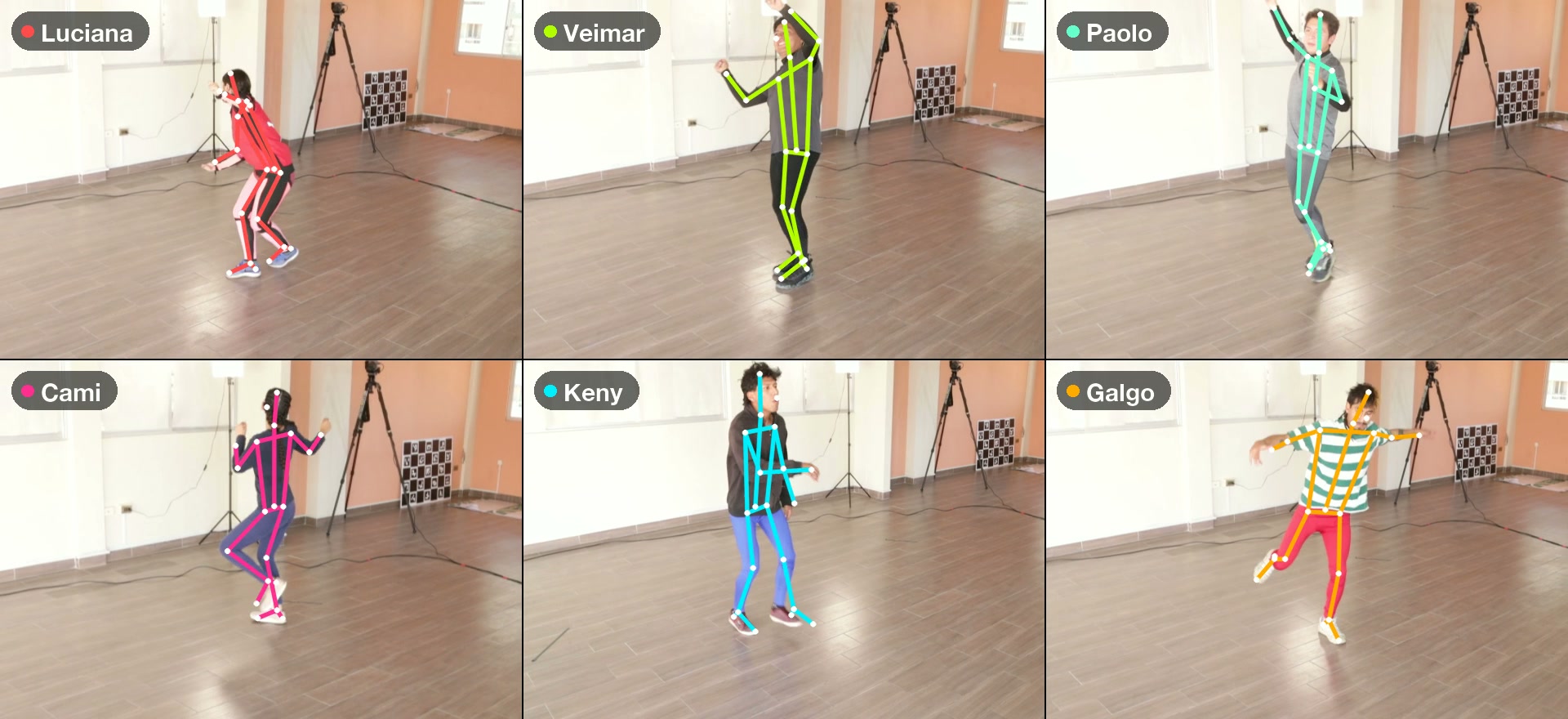
Then they dance in pairs to a second medley: Keny with Paolo, Luciana with Galgo, Cami with Veimar. In the pairs the styles meet: folk dance next to breaking, and Cami answering in jazz.
The plan for the day is Violeta's, and it fits in one line: the same bodies in the three dances, and then the styles meeting.
The music cuts the session
Each take holds three dances, and the model needs to know which is which.
The music tells us. We know the second where the kullawada ends and the tinku begins, and the cameras also record the sound of the room. So every take can be lined up with the music and cut where the dance changes.
The session becomes 35 pieces: 33 minutes of clean movement, each piece with its dance and its dancer. The 25 moments where the music changes dance are kept apart. So is the jazz Cami danced, which the model has not studied.
With them the archive holds 274 takes. 173 are ours, five hours of movement. The other 101 are short takes from AIST++, a public collection of urban dance, 26 minutes in all.
A filter that was unfair to short arms
Before the model studies a take, a filter looks for broken bones. Sometimes the cameras put an elbow or a wrist in the wrong place, and in that frame the forearm comes out too long or too short. The model studies in windows of six seconds, and a window with more than one broken frame in ten is thrown away.
The filter threw away a third of the new session, and nobody lost as much as Luciana. Of her windows, 22 in 100 passed. Of Keny's, 90.
First we blamed her braids: we thought they hid her arms from the cameras. Then we measured. One frame in twenty, the cameras miss her forearm by 7.1 centimetres or more. For Veimar it is 7.9, and for the other four between 5.9 and 6.9. The cameras see her as well as anyone.
The ruler was wrong. The filter called a bone broken when it was off by more than 35 percent of that dancer's own bone. Luciana's forearm measures 19 centimetres and Veimar's 24. So the same camera error broke her frame at 6.7 centimetres and his at 8.5.
Now the tolerance is the same number of centimetres for everyone: nobody is asked for more than the median dancer of the archive. For a dancer with longer bones nothing changes.
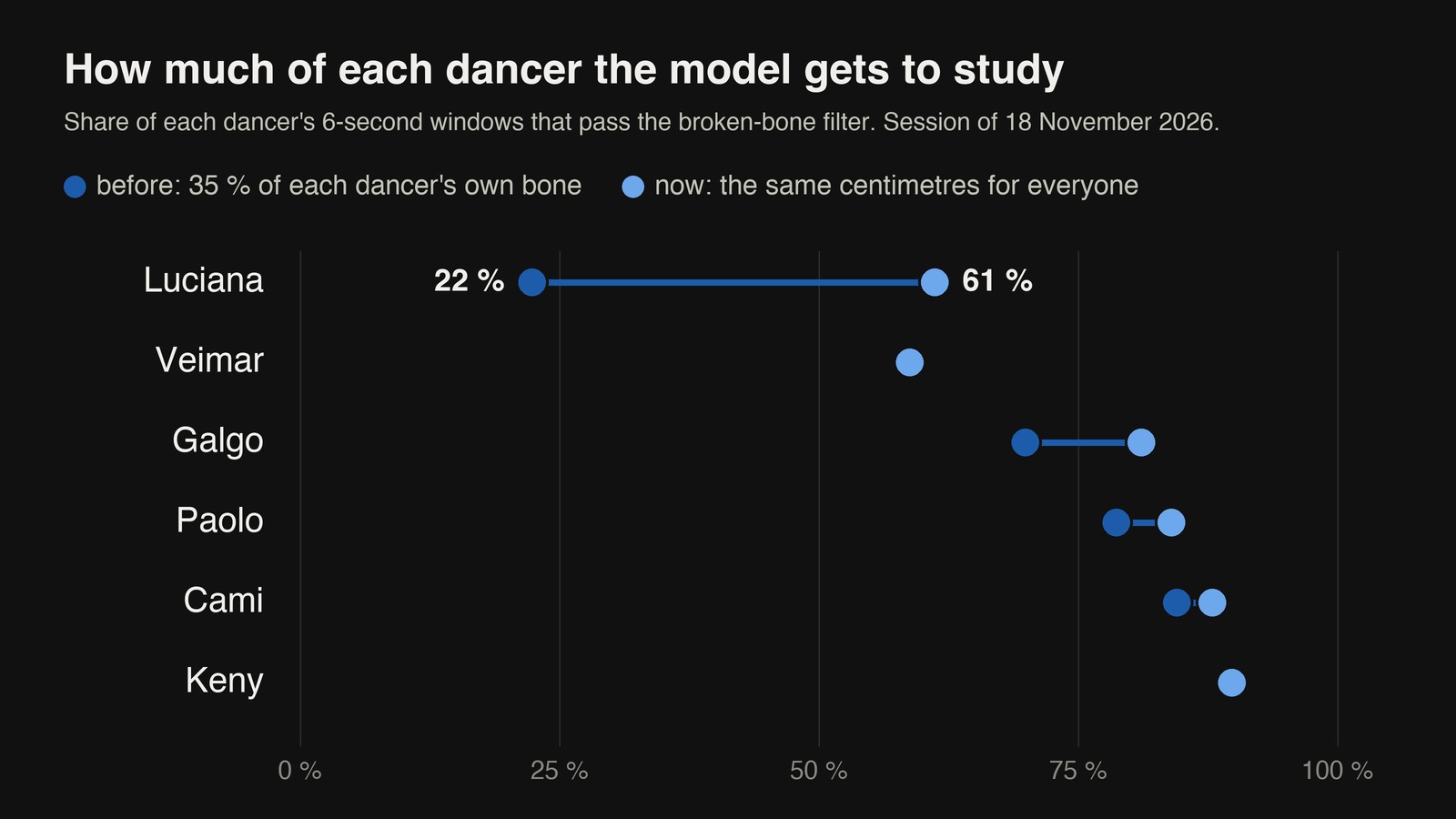
Luciana goes from 22 windows in 100 to 61. The session goes from 805 windows to 925, and the whole archive from 7,417 to 8,208.
It was a bias in our own dataset, and it came from a rule that looked the same for everyone.
The rule we kept: before blaming the capture, measure the error in centimetres, person by person.
The new model moves
The new model studies those 8,208 windows on our own laptop, for more than 14 hours.
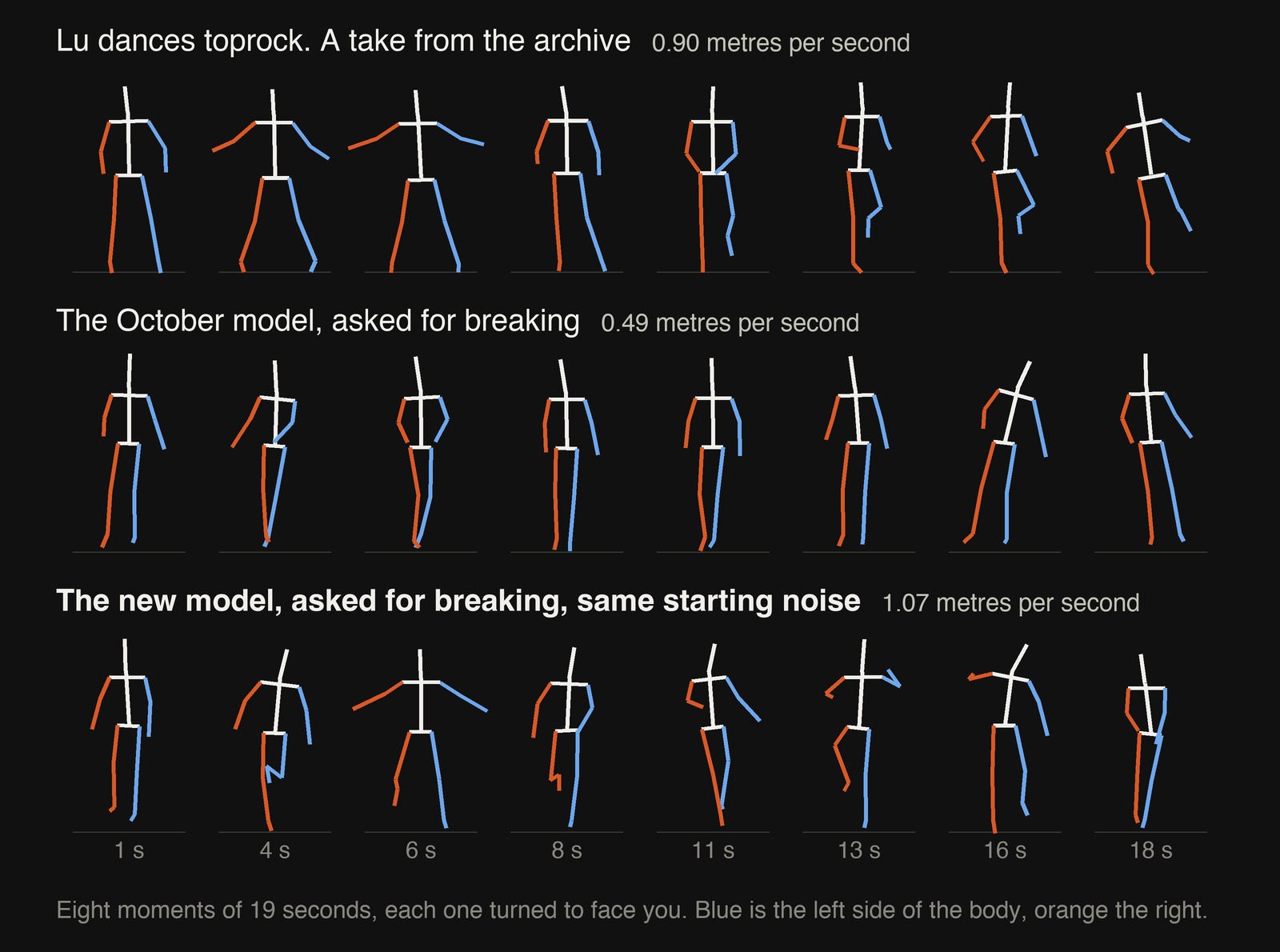
Then we ask both models, the one from October and the new one, for the same thing: eight dances of each style, with the settings of our app. And we put the dancers next to them.
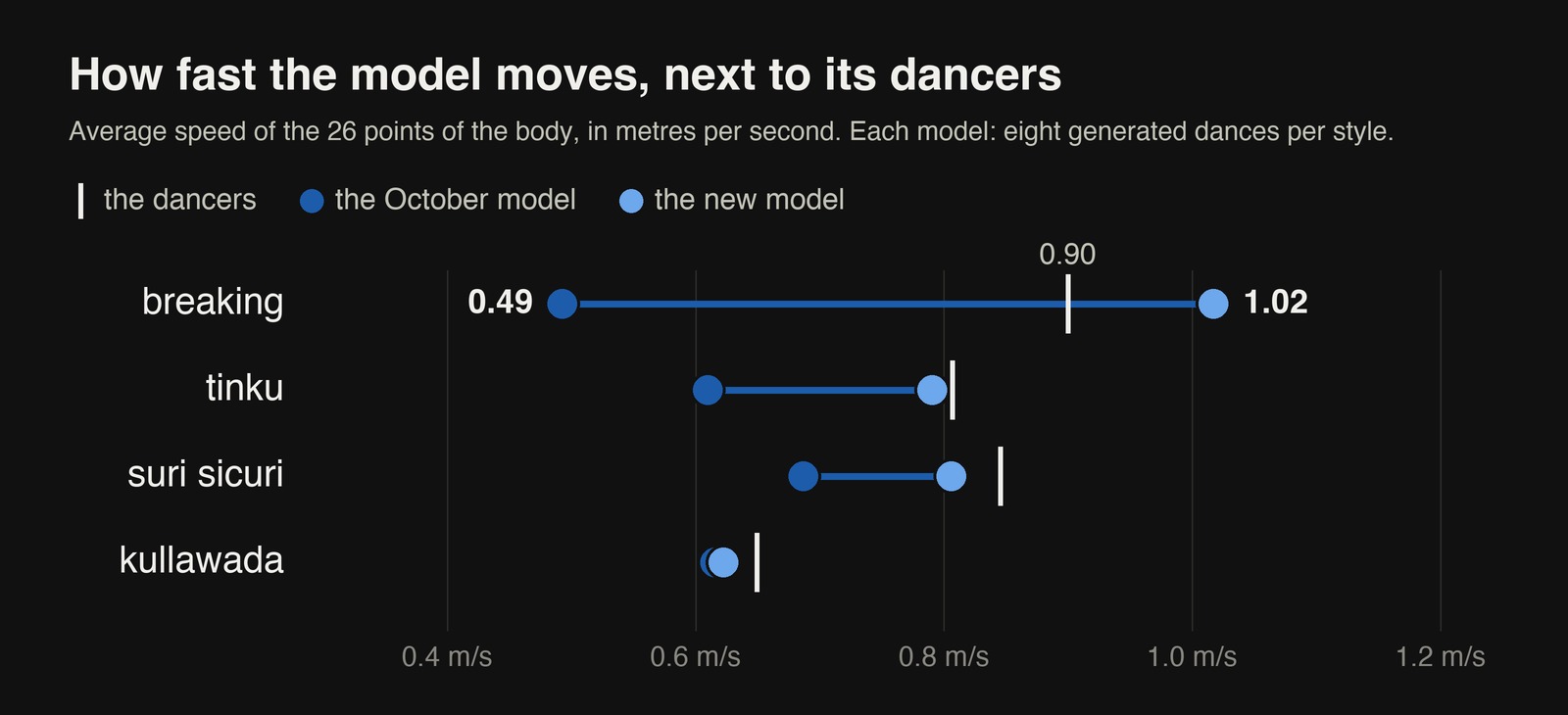
The October model was dancing at half speed. Asked for breaking, its body moved at 0.49 metres per second. The breakers of the archive move at 0.90. The new model moves at 1.02.
The tinku goes from 0.61 to 0.79, with its dancers at 0.81. The suri sicuri goes from 0.69 to 0.81, with its dancers at 0.85. The kullawada, the slowest of the four, stays at 0.62, with its dancers at 0.65.
A model that stands still can pass for a good dancer
In October we measured the old model and it passed.
That measure takes each pose the model makes and looks for the closest pose a dancer made. By that measure the October model still wins at breaking: its poses are 12.2 centimetres per point from a real one, and the new model's are 13.8.
But a body that barely moves is always near something a dancer does. Standing with the arms down is part of every dance. The measure rewarded standing still.
So now we measure both ways. From the model to the dancers, as before. And from the dancers to the model: for each pose a dancer made, how far is the closest pose the model makes? That number says how much of what people do the model never does. In breaking it goes from 16.9 centimetres to 14.0.
And next to every number we put how much the dancers move.
Novel dance, in two bodies
Paqarina generates all the dances it learned: it either generates novel dance or remixes what was danced according to how the pieces fit together.
For the video we ask the new model for novel dance: 48 kullawadas, 48 tinkus and 48 suri sicuris, each written from noise. We measure all of them, look at the best, and keep one of each.
Paqarina is modular: the same 26 points can drive an avatar in Blender or a humanoid robot. In the video the avatar dances breaking twice, once from each model. The three folk dances go to three robots that share one floor, each painted in the colour of its dance: green for the kullawada, pink for the tinku, orange for the suri sicuri.
What we ask the robot to do
We ask the model of the robot, 1.32 metres tall with 29 motors, to copy each dance for eleven seconds: 29 angles, 30 times a second, 9,744 angles for each dance.
The kullawada takes it 1.45 metres from where it starts, with the hips turning 967 degrees in all. The tinku takes it 1.13 metres and bends a knee 119 degrees. The suri sicuri takes it 1.55 metres, turns 1,159 degrees and bends a knee 133 degrees.
Here the three robots are in the computer and they only copy the angles. No policy has practised these three dances, and none of them has gone to the real robot.
What Violeta says in the video
Violeta tells the video in Spanish. These are her words in English, in the order she says them.
This is what we did in the session of 18 November with the dancers. Each one danced the same music alone. Here are all six at once, on the same beat.
Four cameras find 26 points on each body, 24 times a second. This is what the AI model studies: the movement, not the image.
In the duos, each dancer keeps their colour. Folk dance, breaking and jazz meet. We cut the session into 35 pieces: 33 new minutes. With them the archive holds 274 dance takes, and the model studied them for 14 hours.
Breaking created by the model. The old one moved at half a dancer's speed. The new one, which studied your dance, now keeps up.
No person danced these dances. Paqarina's artificial intelligence model created them. Here three robots copy them, on the computer.
Use this note as a source
To cite it: Violeta Ayala, Paqarina's new model dances with the energy of its dancers, United Notions Film, 20 November 2026, unitednotions.film/research/paqarinas-new-model-dances-with-the-energy-of-its-dancers.
The whole note is also a plain text file, with Violeta's words in the video and every number in the pictures. A person can read it, and it can be given to an AI as a source.
Thanks
Paqarina is a Mozilla Fellowship project.
Thanks to Luciana, Veimar, Paolo, Cami, Keny and Galgo, who danced. The dances belong to our community. Music: Sanam. Motion capture: Dan.
What the record shows
| Measure | Value |
|---|---|
| Dancers in the session of 18 November | 6, alone and in 3 pairs |
| Pieces the session became | 35, with 33 minutes of clean movement |
| Takes in the archive | 274: 173 ours and 101 from AIST++ |
| Our movement in the archive | five hours |
| Windows of each dancer that pass the filter, in 100 | Luciana 22 before and 61 now, Veimar 59 and 59, Galgo 70 and 81, Paolo 79 and 84, Cami 84 and 88, Keny 90 and 90 |
| Windows of the session that pass the filter | 805 before, 925 now, of 1,204 |
| Windows the new model studied | 8,208 |
| Training, on our own laptop | more than 14 hours |
| Breaking, metres per second | dancers 0.90, October model 0.49, new model 1.02 |
| Tinku, metres per second | dancers 0.81, October model 0.61, new model 0.79 |
| Suri sicuri, metres per second | dancers 0.85, October model 0.69, new model 0.81 |
| Kullawada, metres per second | dancers 0.65, both models 0.62 |
| What breakers do that the model does not reach | 16.9 centimetres before, 14.0 now |
| Novel dances generated to choose three | 144 |
What remains open
The arms in breaking. When the new model dances with its own proportions, 11 frames in 100 have a bone the filter would call broken, against 4 or 5 in the takes it learned from. Fast arms blur at 24 frames a second, and that is where the cameras miss.
Whether the new energy comes from the new session or from the luck of one training run: there is one run of each model. Whether jazz becomes a fifth dance.
The new model has been the one in our app since 20 November. Next come the pairs: what two dancers do with the floor between them goes to the planner.